Wednesday, July 28, 2010

Capitania General de Florida, Battle #1 (More Pictures)

As promised on my Col Campbell's Barracks blog, here are some more pictures of the action.  The first three pictures were taken by me and the remainder were taken by "Electric" Ed.  Please click on the pictures for a larger image.

The Asturian militia face off against the Britannian rangers and light infantry.

The left flank Asturian infantry battalion has deployed against the Georgiana militia who are safely skulking behind some woods.

The Britannian rangers and light infantry have broken into the breastworks only to find the Asturian militia has pulled back towards their supports.

Another overview of the battlefield with the Indian stockade in the foreground and the fort clearing in the background.

The Austirian militia mans the breastworks in the fort clearing.

A close-up of part of the above picture.

Another overview of the battlefield from a slightly different angle.  Most of the wooded areas were passable as rough terrain but some of them (such as the one directly in the center foreground) were imapssable thickets of vines, creepers, and swampy ground.

One of the Britannian battalions and the rangers and light infantry commands enter the battlefield.  The mounted officer is the overall Britannian commander, Leftenant Colonel "Roman" Young.

The attack by the rangers and allied Indians against the Asturian militia.

Another shot of that attack.  "Electric" Ed commanded the Britannian rangers and light infantry.

Two of Baron de la Plata's Asturian battalions march towards the action.  The Hibernian battalion is on the right with their bright red coats.

A long shot of the two battle lines, from the Asturian militia and Britannian light infantry and rangers in the foreground to the embattled Indian stockade in the background.  I think the hands belongs to Lord Sterling (Baron de la Plata) (on left) and young Master Sean who commanded the Georgiana militia (on right).

Asturian battalions deploy into battle lines.  The white coated battalion claimed the center against the Britannians while the Hibernians would have to settle for manning the reverse of the breastworks against the advancing Britannian light infantry and rangers.

The Georgiana militia (to the left) and a Britannian battalion (to the right) attack the Indian stockade which is being supported by one of Baron de la Plata's Asturian battalions.
By the way, that is not a Martian tripod, but my camera.

At the end of the action, the Hibernians begin to advance across the fort clearing against the Britannian light infantry.  If you look closely on the left, you can see the remnants of the Asturian militia (blue flag) and just beyond them are some Britannian rangers who have occupied a wooded area behind the Hibernian flank.  Nothing came from this flanking move as the Britannian right flank collapsed.

The Georgiana militia attempts to scale the stockade wall (somebody forgot to make ladders! -- That would have been me.), while the Britannian and Asturian battalions trade volleys.  The Georgiana militia and the Britannians both fell below 50% strength and then failed their critical morale rolls, withdrawing from the battlefield.  The fighting ended as the rest of the Britannians were severely outnumbered at that point.


Saturday, June 19, 2010

Bayou Wars 2010

Many members from the Jackson Gamers made our annual trip to New Orleans to participate in the Bayou Wars gaming convention on June 11-13. We also competed with other gaming groups in a gaming competition. The Bayou Wars staff asked each group or club to run 5 games during the weekend. The games were judged and last week we were told we had won the competition. Next year at Bayou Wars our game masters each get a free hot dog!

I ran the first game, a space ship battle based on the Honor Harrington universe. I used the Full Thrust rule set and modified it to fit my needs.

Here is the set up for my game.


Early in the game I am working with one of the Peoples Republic players as he leads a raid into a Manticore controlled system.


The Manties were able to win this when they destroyed a heavy cruiser for the loss of a destroyer.

Our next game was run by Mark Stevens. He ran a Sikh wars game using the Sword in the Punjab variant of the Sword and the Flame rule set.


Here is the set up for his game. Mark is in the maroon shirt.


Late in the game. Jim Pitts confers with Martha Stevens.


Saturday morning Jim Pitts also ran a colonial game using The Sword and the Flame. Jim's game was the relief of the garrison at Wadi Zoum Zoum.

Here is Jim giving instructions at the start of the game.


The garrison, at the wadi can be seen in the middle of the table.


Near the end of the game, British reinforcements have arrived by steamer and are able to hold the garrison.


Our fourth game was by Jay Stribling. He ran a Spanish-American naval battle using his own rule set.
Here is Jay setting up the game. The Spanish had to break out of the port and run along the coast to try and get away from the American blockade. The Spanish commander was able to get 3 ships away which was a major victory for them.


Our fifth game was run by Bill Hamilton. It was a Victorian Sci-Fi game using Aeronuf miniatures and using his own rules. It had a lot of players was was well liked. Unfortunately I didn't get any pictures of this game.

Other Jackson Gamers ran games that were not part of the competition. Overall we had an excellent time at Bayou Wars and are looking forward to next year.

Saturday, June 5, 2010

Play Test of "Remember the Maine and to He** with Spain"

Today several of us play tested Jay's Bayou Wars game, Remember the Maine and to He** with Spain!.  Jay has modified Travis' Seas of Steel WW2 naval rules to accommodate the much less technological pre-dreadnought ships of the American and Spanish navies.  Jay also made some equalizing changes in both naval orders of battle, especially the Spanish.  Jay's game will be on Saturday afternoon at 2:00 pm. (Convention schedule and details at the Bayou Wars home page.)

Remember, please click on the pictures for a larger image.

We played the scenario through twice as it went very fast!  The first play through was the original orders of battle:  the Spanish four cruisers and two torpedo boat destroyers versus the Americans four battleships, two cruisers, and two armed yachts/torpedo boat destroyers.  All ship models are 1:2400 scale and are from Panzerschiffe's Spanish-American War range (link).

The Spanish cruisers (Maria Teresa, Almirante Oquendo, Viscaya, and Cristobol Colon) break out of the harbor of Santiago de Cuba.

The USS Oregon quickly gets underway in pursuit of the Spanish squadron.  Even though she had speed-sailed from the Pacific, she was the most combat ready of the American ships.

The Uss Iowa and the USS Indiana slowly get underway.

The older coast defense ship USS Texas (or a reasonable facsimile thereof) slogs away from her anchorage.

The four Spanish cruisers speed away from the American ships.  It is every captain for himself and the Devil take the hindmost!

The cruiser USS Brooklyn leads the USS Texas and the USS Oregon after the fleeing Spanish ships.  While the Oregon was at full speed, the  Texas and the Brooklyn were never able to gain full speed.

What's this?!?  A torpedo hit on the USS Iowa!!!
A  Spanish torpedo boat destroyer was able to get close enough to loose a torpedo which actually struck its target before the destroyer succumbed to American gunfire.  The Iowa slowly began to take on copious quantities of water and the captain ordered, "Abandon ship!"

The USS Gloucester, with no more Spanish torpedo boat destroyers left, rushes to rescue the crew of the sinking Iowa.

The Spanish cruisers get more separated as their different speeds begin to tell, as does the damage inflicted by the American gunnery.

A closer shot of two of the Spanish cruisers, the Almirante Oquendo on the right and the Cristobol Colon (I think) on the left, as they flee from the Americans.

The first Spanish cruiser (Maria Teresa ,I think) succumbs to the concentrated American gunfire.

But the Spanish also draw more blood as they sink the USS Brooklyn which was leading the American charge and was the target for several of the Spanish cruisers.

But the Americans get revenge, putting the Almirante Oquendo under the waves.

The Cristobol Colon is the next (and third) Spanish cruiser to be sunk.

And finally the Viscaya joins her sisters in Davy Jones' locker.

Final results:  Spanish -- four cruisers and two torpedo boat destroyers sunk versus American -- one battleship and one cruiser sunk.

We then reset the game and add more Spanish and American ships.  The Spanish ships were the battleship Pelayo, two armored cruisers, an unprotected cruiser, and three torpedo boat destroyers.  The Americans added the USS New York, the USS Massachusetts, and a torpedo boat destroyer.  Could the additional Spanish ships swing the tide against the Americans?  Nah, not really.  The additional Spanish heavy ships were played by stand-ins as Jay had not received his order yet from Panzerschiffe.

This was, I think, the stand-in for the Pelayo.

And here is the stand-in for the Carlos V, an armored cruiser.

The Spanish armada (strung out on the left) and the American fleet (on the right) make similar moves as the Spanish attempt to flee down the coast.  The Spanish torpedo boat destroyers tried to close with the American ships but were quickly blown out of the water before they came within torpedo range.

One by one, the Spanish ships were blasted to bits (two are shown sinking on the left) but the American cruiser Brooklyn was sunk again.  The lead Spanish cruisers ganged up on her.

Final results:  Spanish - one battleship, seven cruisers, and five torpedo boat destroyers sunk versus one American cruiser sunk.

So, lessons learned:  Even with the tweaks in increased gunfire ability and armored protection and in more ships, the Spanish were still outclassed by the American fleet.  Should the Spanish have tried to immediately close the range and engage the Americans in a close-range gunfight?  Maybe that's something for the Bayou Wars Spanish players to try.  One thing we did note was that the Spanish torpedo boat destroyers should be sheltered behind the bigger Spanish ships until the range is closer so they can try to get in torpedo range while the Americans have many targets for their secondary batteries.  When the TBDs try to close early, the Americans can shoot at them with the secondary batteries while the Spanish heavies are out of those guns range.

But whatever happens, it is a fun, quick game that might see two complete run-throughs Saturday afternoon.

Monday, May 31, 2010

Escape of the Agincourt playtest

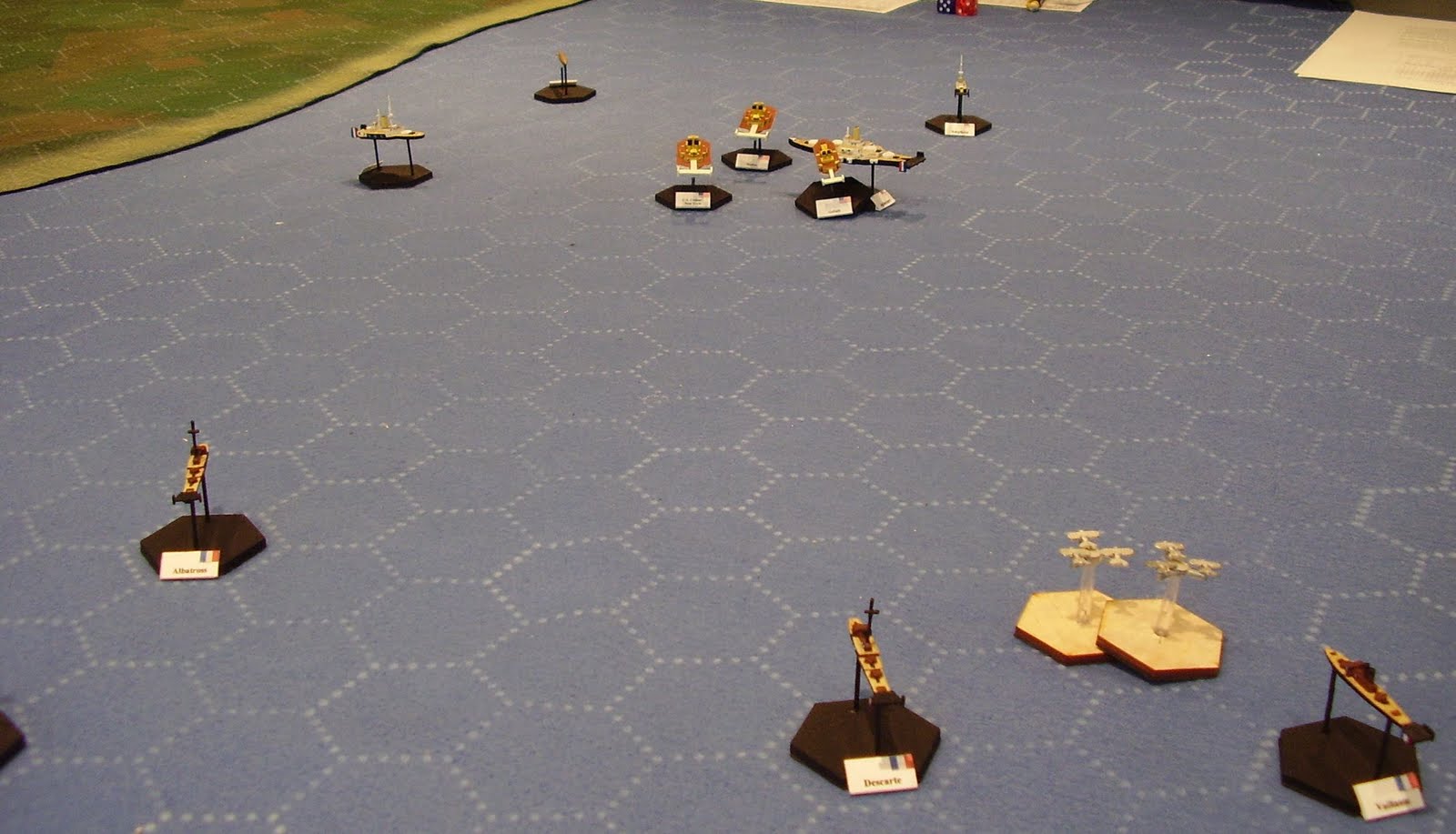
On May 29th, we played a test game of my Bayou Wars game, Escape of the HMS Agincourt. We actually played two games, as it became obvious in the first playthrough that I made some errors in setting it up. The goal of the British and Americans was to get the Agincourt off the far table end, while the Germans and French had to destroy her.

Here are photos of the two games, along with commentary. As always, click to view a larger image.


The British light cruiser Rawalpindi, commanding the British coastal defense digs.


The rag-tag remnants of a strike fleet comprised of British and American ships frantically make their way back to Britain's shores.


A small squadron of British Aeronef were in their docks for refit and lifted off to assist in the defense.


A French raiding flotilla racing in to cut off the British fleet's escape.

The strike fleet turns to gain more distance against the faster French vessels, with the Agincourt struggling along behind.


British fire caused a critical hit which set this German vessel ablaze. The red marker on the Rawalpindi indicates that the ship has fired, to help the players keep track.


French fighters (launched from the 'dig carrier Les Arc) swarm after the Agincourt as the Germans and French encircle her. This is where I began to see the problem I had created; the Agincourt simply wasn't fast enough to escape. After some discussion, we decided to reset the game and fiddle with the settings a bit.


Setup was much the same. We added some coastal defense batteries, marked by the empty bases along the coastline.


The strike fleet moves straight toward the coast as the enemy quickly closes the distance. This time, the engine damage wasn't as severe, only limiting her to Cruise speed rather than Slow.


Fire from the defense batteries takes its toll on the French cruiser Formidabile, causing fires to break out on her hull.


The French destroyer Albatross, her weapons batteries reduced to uselessness, flees the battle while the Les Arc launches more fighters in the distance.


The swift French vessels were torn to pieces by the concentrated fire of the British and Americans. Note that the defensive batteries have moved; we decided the fire was _too_ concentrated, and spread them out more so they wouldn't be quite so overpowering.


The fleet moves closer to its goal, harried by the Les Arc's fighters. The Germans continue to close, heavy fire tearing into the fleet. The Agincourt took two criticals at this point. One damaged the engines further, reducing her to a maximum of Slow and forcing her to coast to a halt until repaired. The second damaged her rudders, locking her into a slow left turn. The rudder damage was repaired at the end of this turn.


Two turns later. The Agincourt never managed to repair her engines. the attacking ships managed to penetrate the defensive batteries and destroy her from point-blank range.


Overall it went well. The second game took about two and a half hours, with players who were familiar with the system. The game itself is easy to pick up (it is based on A Sky Full of Ships, though heavily modified). I expect that I can easily explain the rules to the players and comfortably fill the four hour time slot.